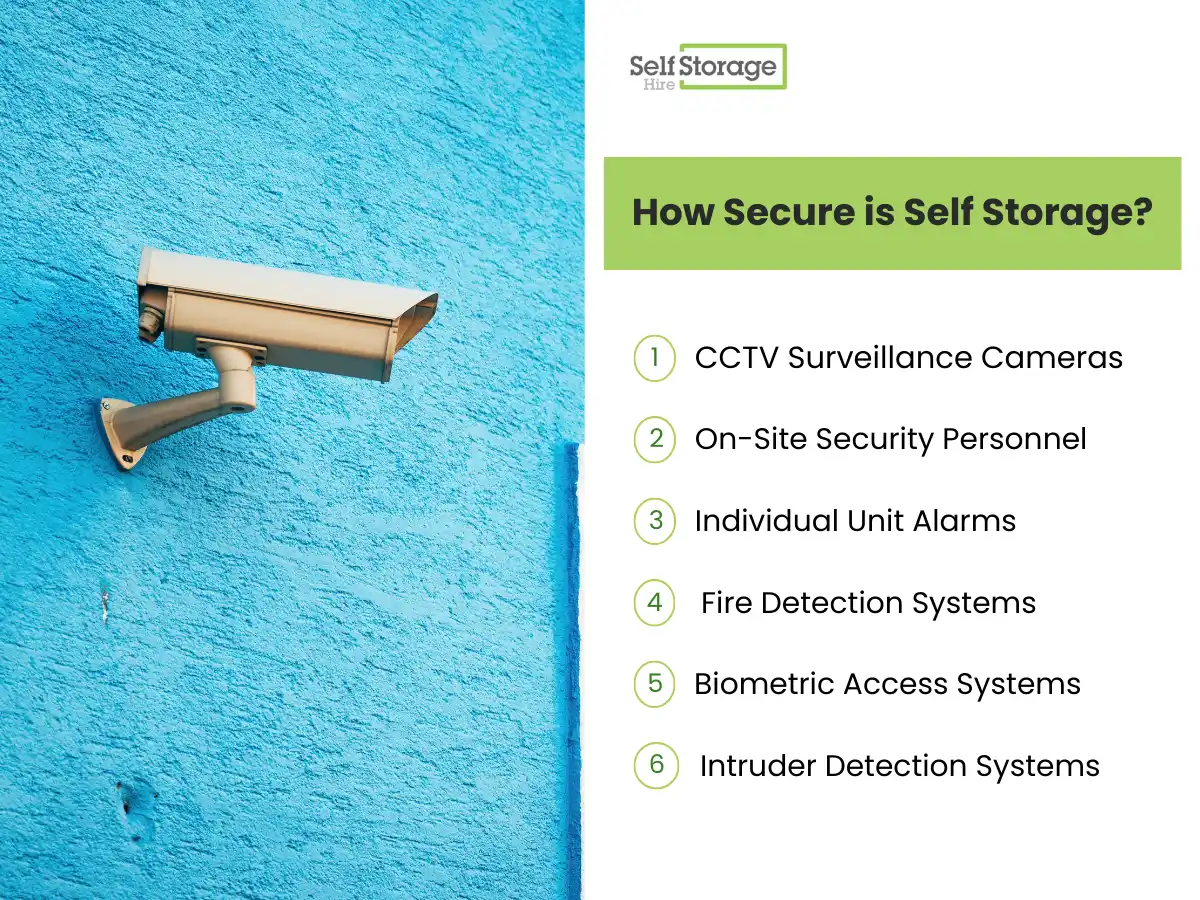

Self storage is secure because most modern self-storage facilities use 24/7 layered security systems such as controlled access, continuous surveillance, on-site monitoring, unit-level alarms, and fire detection to reduce theft, unauthorised access, and physical damage. These combined security attributes create a controlled environment that protects stored belongings more reliably than relying on a single security feature.
In practical terms, self storage security depends on how access, monitoring, and response systems operate together at all times. Entry is restricted through digital access controls that log every visit, surveillance cameras actively monitor activity and capture high-quality footage, and trained staff or remote teams respond to alerts triggered by unit-level alarms or intruder detection systems. Fire detection and prevention technologies reduce environmental risk, while well-lit facilities support visibility and safety. When these systems are integrated and consistently maintained, self-storage provides a high level of protection for personal and business items.
What Are the Common Security Features in Self Storage?
Common security features in self-storage include controlled access systems, CCTV surveillance cameras, on-site security personnel, individual unit alarms, and fire detection systems. These security features work together as layered security measures that limit access to authorised individuals, monitor activity across the storage facility, detect intrusion attempts, and respond to emergencies such as fire hazards. When combined, these systems reduce theft risk, enhance storage unit security, and help safeguard customers’ belongings in a well-maintained, monitored storage environment.
| Security Feature | Risk Type Addressed | How the System Works | Protection Level | Customer Impact |
| Controlled Access Systems | Unauthorized entry | Keypads or key cards restrict entry to authorised individuals | High | Limits access to the storage facility |
| CCTV Surveillance Cameras | Theft and burglary | Cameras monitor activity across entry points and common areas | High | Records incidents and deters intrusion |
| On-Site Security Personnel | Suspicious activity | Staff patrol the property and respond to alerts | Medium | Enables immediate supervision |
| Individual Unit Alarms | Unit-level intrusion | Alarms activate when a storage unit is tampered with | High | Protects specific storage units |
| Intruder Detection Systems | Forced entry | Sensors detect unusual movement or access attempts | High | Detects threats quickly |
| Fire Detection Systems | Fire damage | Smoke detectors trigger alerts during emergencies | High | Reduces damage to stored items |
| Well-Lit Storage Facilities | Night-time intrusion | Lighting improves visibility across the property | Medium | Improves safety during access |
| Biometric Access Systems | Identity misuse | Fingerprint or facial scans verify personal access | High | Prevents shared or stolen access |
| Timed Access Hours | After-hours entry | Access control systems limit entry by time | Medium | Reduces unauthorised access windows |
Controlled Access Systems
Controlled access systems are used to manage entry into a self-storage facility through keypads, key cards, smart systems with mobile app or Bluetooth access, and key fobs assigned to authorised users. These systems restrict who can enter the storage facility and support storage unit security through individual unit locks, unit-level alarms, and hands-free gate access, reducing tailgating and unauthorised entry.
Many facilities also rely on digital logs and License Plate Recognition (LPR) systems to record entry activity and automatically identify approved vehicles. This level of access control helps storage providers monitor movement and respond to irregular activity. An ASIS International report indicates that 71% of facilities experienced no more than 5 serious security incidents, while 85% reported fewer than 10, highlighting the role that controlled access systems play in lowering overall security risk.
Surveillance Cameras (CCTV)
Surveillance cameras, commonly known as CCTV, provide 24/7 monitoring of a self-storage facility, including entry points, corridors, and shared areas. These systems are important because they deter theft, reduce blind spots through effective placement, such as 360-degree views, and create high-definition footage that serves as evidence during incident resolution.
Modern CCTV systems support active monitoring with remote access, night vision, instant alerts, and integration with access logs to accurately track activity. Actively monitored cameras allow security personnel to respond quickly when irregular behaviour is detected. Research by Piza (2024) found that actively monitored CCTV cameras are associated with a 15% reduction in crime, highlighting their role in improving storage unit security.
On-Site Staff and Security Personnel
Human supervision strengthens 24/7 safety and security within a self-storage facility by ensuring security measures are actively enforced rather than passively installed. On-site staff and trained security personnel reduce risk through scheduled patrols, visible presence, and active monitoring of facility activity, which helps discourage unauthorised access and suspicious behaviour.
Their responsibilities often include monitoring CCTV feeds, reviewing access logs, responding to unit-level alarms, and providing immediate incident response during theft attempts, access violations, or emergencies such as fire alerts. Many storage facilities rely on hybrid security models, where personnel work alongside advanced technologies such as access control systems, surveillance cameras, and intrusion detection systems. This combination improves response speed, supports coordinated incident resolution, and adds a human decision-making layer that automated systems alone cannot provide.
Individual Unit Alarms
Unit-level security becomes more precise when each storage unit is protected by its own alarm system rather than relying only on facility-wide controls. Individual unit alarms are designed to detect unauthorised access at the exact point where stored belongings are kept, which helps prevent silent tampering or forced entry.
These systems use door and motion sensors to detect activity, triggering local sirens and sending real-time notifications to security staff. Many facilities manage these alerts through cloud-based software with remote access, allowing quick verification and response. When integrated with access control and surveillance systems, individual unit alarms create a direct, responsive layer of protection that improves storage unit security and incident response.
Intruder Detection Systems
Threats are not always limited to entry points, which is why intruder detection systems focus on identifying unusual activity across the entire storage facility. These systems matter because they detect unauthorised movement inside restricted areas, around unit corridors, or along the perimeter, even when standard access controls are not actively breached.
Intruder detection relies on perimeter alarms, motion detectors, door sensors, and magnetic contacts that trigger alerts when abnormal activity is detected. Many facilities now use infrared motion detection and AI-enabled cameras, connected to integrated systems that send alerts via mobile apps for 24/7 remote monitoring. Some setups include built-in speakers and microphones to support verification and response. When connected with keypad access and surveillance platforms, these systems improve operational efficiency by enabling faster detection, assessment, and response to security incidents.
Fire Detection and Prevention Systems
Fire detection and prevention systems are designed to identify early signs of smoke, heat, or flames before fire damage spreads across a storage facility. These systems are relevant because risks such as electrical failures or overheated equipment can affect multiple storage units at once, making early and accurate detection critical for protecting stored belongings.
Modern storage facilities employ wireless and addressable alarms, smoke and heat detectors, aspirating smoke detection systems such as VESDA, and thermal imaging to identify fire risks at an early stage. Audible and visual alarms alert staff immediately, while sprinkler systems and other suppression technologies help contain the spread. Passive fire protection measures, including fire-rated compartments and clear emergency procedures, further limit damage. When combined with staff training and proactive risk assessment, these integrated systems improve response time and overall fire safety.
Well-Lit Storage Facilities
Lighting directly contributes to safety and theft prevention in a self-storage facility by improving visibility across all accessible areas. Bright, well-lit environments discourage unauthorised activity, enhance security awareness, and help prevent slips and falls for customers moving through driveways, corridors, and unit access points.
Secure storage facilities typically use high-quality LED lights and motion-sensor lighting to maintain consistent illumination during low-light hours, including inside climate-controlled storage areas. Proper lighting enhances camera visibility in surveillance systems, supports on-site patrols, and creates a safer, more pleasant environment for customers. When combined with access control and monitoring systems, well-lit facilities strengthen overall security and reduce accident-related risks.
Biometric Access Systems
Biometric access systems strengthen storage facility security by verifying identity using biological characteristics that cannot be faked or shared. These systems improve security tracking by creating a unique user profile for each customer, reducing liability and limiting the risk of lost or shared credentials while maintaining convenient access.
Common biometric methods include fingerprint scanning, facial recognition, and iris scanning, all of which support real-time monitoring and detailed access logs. Facility managers can instantly manage user permissions, enabling immediate activation or deactivation of access when needed. According to Janus International Europe, facilities using biometric access systems have reported up to 95% fewer break-in claims, demonstrating how identity-based access control significantly improves overall storage unit security.
Timed Access Hours
Access timing is a key control that determines when activity can occur within a self-storage facility. Timed access hours define secure windows during which customers are permitted to enter, helping storage providers reduce risk during periods when supervision and monitoring are limited.
These controls are enforced through computerised gate systems connected to access control software, keypads, and biometric systems that log every entry attempt. Most facilities offer standard access aligned with office hours, while extended access outside these hours requires special authorisation or renewal by phone. By applying clear restrictions, tracking usage digitally, and limiting after-hours entry, timed access hours improve oversight, reduce unauthorised activity, and maintain consistent security standards across the facility.
How Much Does Self Storage Cost?
Self storage typically costs between £10 and £50 per week or £40 to £200 per month, depending on storage unit size, location, security features, and rental duration. Smaller storage units are priced at the lower end of the range, while larger or climate-controlled units cost more due to the added protection they offer for sensitive belongings. Facilities offering advanced security features, such as controlled access systems, surveillance cameras, and unit-level alarms, may also charge higher rates due to the increased level of safety they provide.
Prices vary noticeably by region, which is why self storage cost often reflect local demand and property values. In London, storage commonly ranges from £20–£60 per week or £80–£210 per month, while Manchester averages £20–£30 per week or £85–£170 per month. More affordable options are found in Doncaster at £10–£25 per week or £40–£100 per month, Bristol at £10–£40 per week or £40–£160 per month, and Edinburgh at £12–£35 per week or £50–£140 per month, highlighting how location directly influences overall pricing.
How to Choose Secure Self Storage Facilities?
Choosing a secure self-storage facility means checking whether the site uses controlled access systems, active surveillance, on-site monitoring, unit-level protection, and fire safety controls as part of its standard security setup. These measures work together to limit unauthorised access, reduce theft risk, and protect stored belongings from physical and environmental hazards.
6 key factors to check when choosing self-storage facilities:
- Controlled access systems using keypads, biometric access, or digital credentials
- CCTV surveillance cameras with active or remote monitoring
- On-site staff or security personnel for patrols and immediate incident response
- Individual unit alarms and intruder detection systems
- Well-lit storage areas to improve visibility and safety
- Fire detection and prevention systems with alarms and suppression support
Reviewing these elements together helps compare self-storage facilities based on how well their security systems operate as a complete setup, rather than relying on isolated features that may not provide consistent protection.